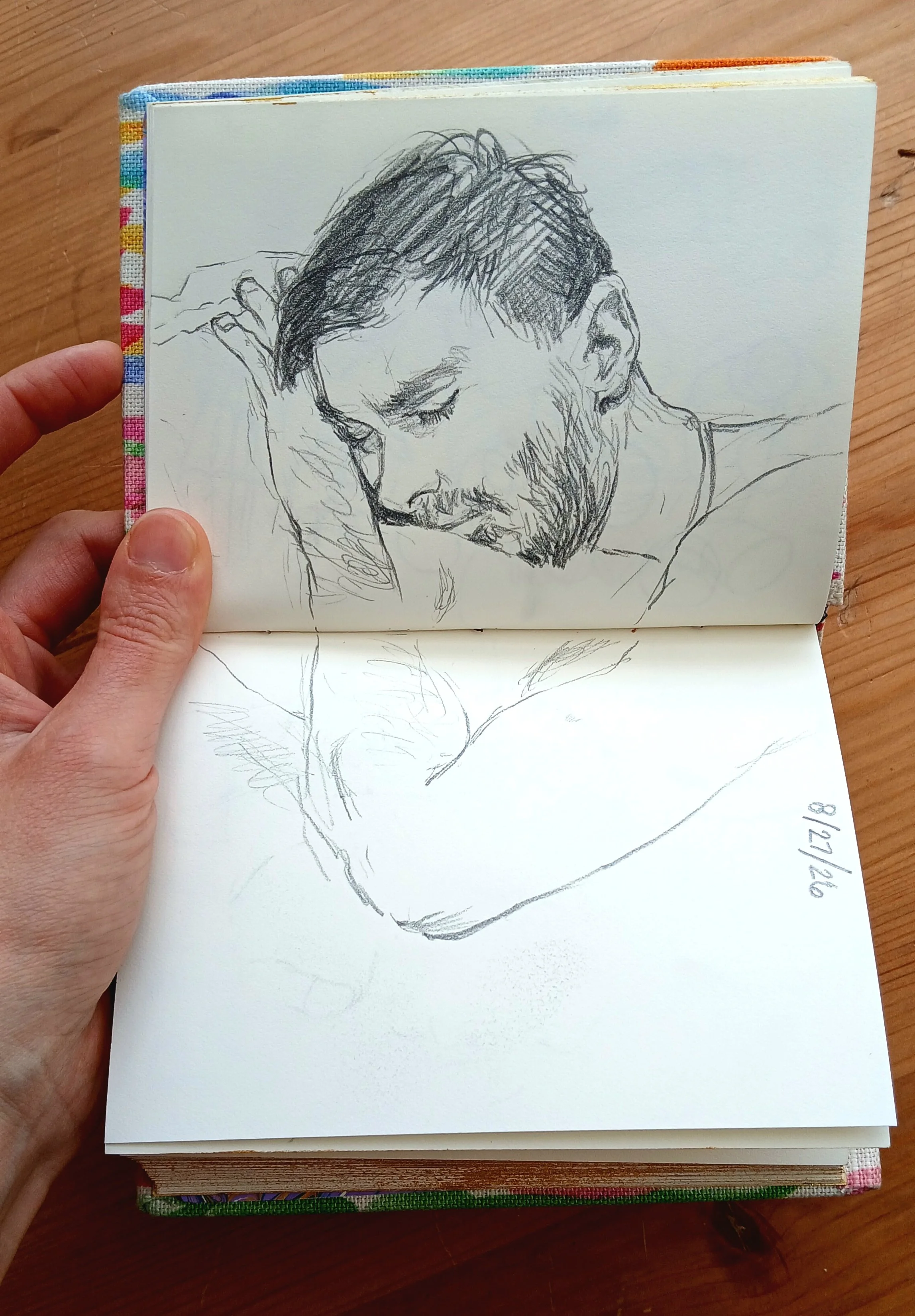
Saturday August 29, 2026
What drawing asks of me
Drawing asks me to pay attention.
It asks me to sacrifice whatever fleeting intrusive thoughts I was chasing in exchange for presence.
It asks me not to be distracted in a world determined to steal every unused scrap of my life force.
It asks me to face life head on and challenges me to love it and appreciate it.
Every drawing I make shows me the quality of my attention. They’re records of my state of mind.
I know when I’ve been drawing with an anxious, sad, and judgmental mind. I also know when I was drawing for enjoyment, fun, and curiosity.
———————————————————————
I went through a long period of survival mode following art school when my world became flooded with strained family relationships and financial worries. I felt shame to admit it at the time, but up until then I received most of my sense of self-efficacy and identity through being a high-achieving student and being “good at art". My belief in myself fell off a cliff in the months after graduation.
When I was young, drawing was an activity I did for fun and enjoyment almost every day. But by this point in my life (I realize this now), I had attached some ulterior motive to drawing. Whether it was a general pressure to “be good enough,” making something worthy of exhibition, or something that could sell, drawing had become a yardstick I used to measure my self-worth and metaphorically beat myself with. It filled me with guilt, not seeing it as a necessary and productive activity to solving my real problems. So I stopped.
I shifted into making functional items (primarily focusing on marbled paper and bookmaking) because these were “safe” creative outlets. I enjoyed it a lot, but I couldn’t ignore the anxious fear that I was holding back an important part of who I am by avoiding the blank page. It was much easier for me to make sketchbooks than to draw in them.
It took courage to start again, because I knew I was going to have to shift my self concept and let go of all this baggage. Drawing asks me to leave all of that behind. I had to release the need for certainty and the need to be good. Anyone who’s wanted to make a change in their life knows that there’s a difference between knowing what to do in your head and actually embodying a change.
Around 2022, I slowly but consistently started making marks again in my sketchbook. I judged them. I didn’t like the feelings they were triggering inside me—guilt, shame, frustration, but I kept going. I had periods of stress when I stopped again. and I would beat myself up about it. I’ve gotten better at releasing those self-judgments, but it’s taken years. Derek has also helped me to release these judgments of myself and live more joyfully.
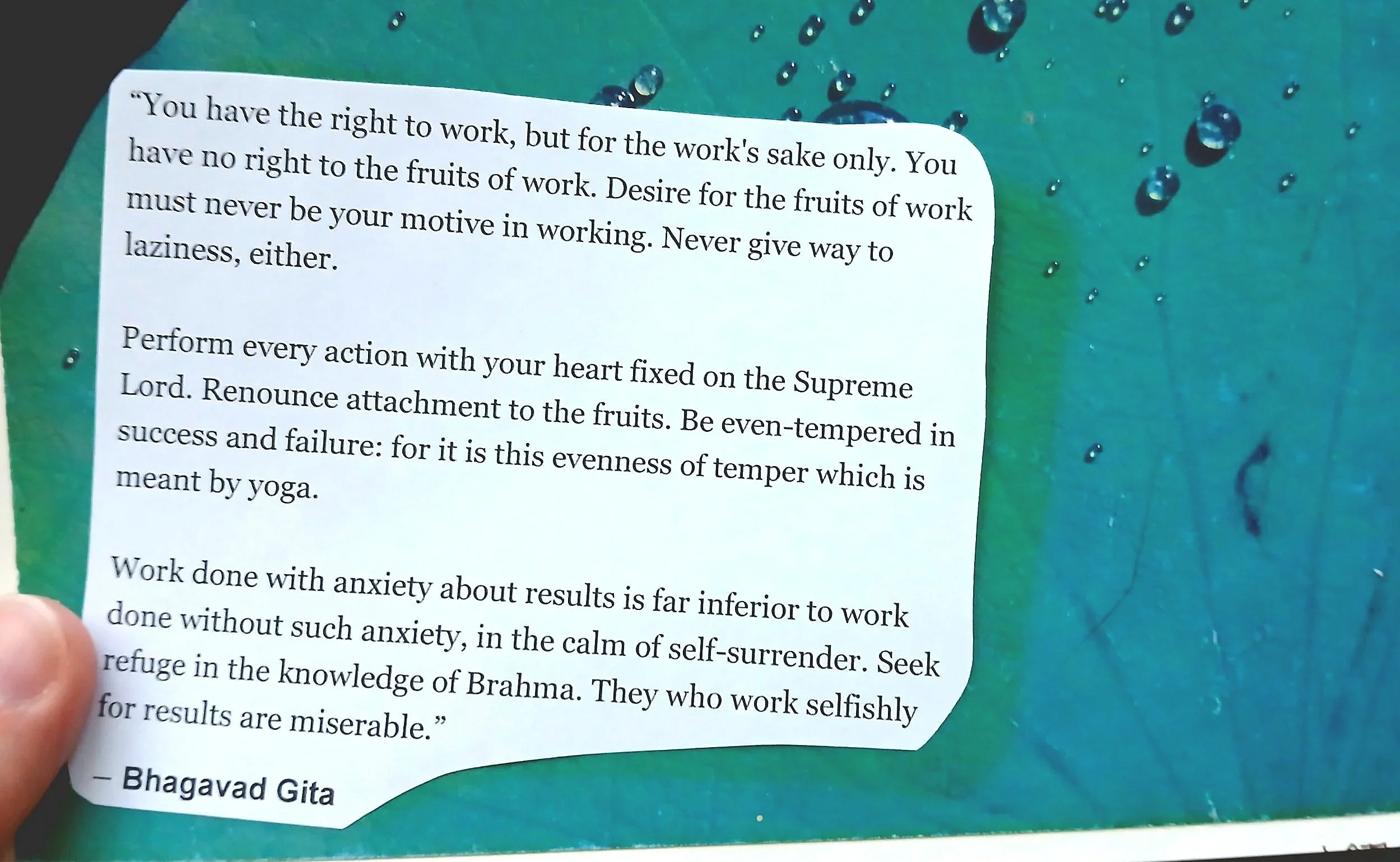
There’s a quote I think about a lot from the Bhagavad Gita:
Of course there are real economic realities. In this age of social media comparison, it can be easy to slide into the line of thinking—conscious or unconscious—that goes “Well shoot… If I can’t do the thing perfectly (or at least well enough that I can make a living from it), then it isn’t worth doing.”
This is the biggest lie and also a tragedy.
Engaging with the process is always the real reward, not “being good.” The joy of giving my attention completely for a few minutes to an object or person of interest and observe it for drawing…when everything else disappears…this is a sacred space. It’s medicine for my prone-to-overthinking mind. When my attitude is correct, drawing makes me feel vivacious, calm, and joyful. I wish I could share that feeling with everyone.
“Don’t aim at success. The more you aim at it and make it a target, the more you are going to miss it. For success, like happiness, cannot be pursued; it must ensue, and it only does so as the unintended side effect of one’s personal dedication to a cause greater than oneself or as the by-product of one’s surrender to a person other than oneself. Happiness must happen, and the same holds for success: you have to let it happen by not caring about it. I want you to listen to what your conscience commands you to do and go on to carry it out to the best of your knowledge. Then you will live to see that in the long-run—in the long-run, I say!—success will follow you precisely because you had forgotten to think about it.”